

Yes, a misting system needs a water filter, and it matters more than most people expect. A high-pressure misting nozzle pushes water through an opening far smaller than a pinhead. Minerals, sediment and scale that you'd never notice in a glass of water are more than enough to block it. Good filtration is the difference between a system that runs smoothly for years and one that starts dripping and sputtering in its second summer.
Here's what's actually happening inside your system, and how to keep it clear.
Why Misting Nozzles Block Up
A high-pressure system forces water through each nozzle at around 1,000 psi to break it into droplets as small as 8 to 10 microns. To do that, the nozzle opening has to be tiny. Anything solid in the water has nowhere to go.
There are three common culprits:
- Hard water. Water that's high in dissolved minerals, especially calcium, leaves scale behind. It builds up inside the nozzle and around the tip over time, the same way it does inside a kettle.
- Sediment. Fine sand, rust particles and debris from pipes, tanks or bores can lodge in the nozzle and block it outright.
- Build-up in the line. If unfiltered water sits in the misting line between uses, minerals and sediment can settle and then get pushed into the nozzles the next time the pump starts.
Our nozzles have their own small stainless-steel filter screen to catch larger particles, but they can't stop dissolved minerals. That's the job of the main water filter.
How to Tell Your Water Is Causing Problems
You'll usually see the signs before the system stops working:
- white or chalky crust on the nozzle tips
- an uneven spray, where some nozzles mist well and others spit or barely work
- dripping from nozzles after the pump switches off
- the pump working harder or the spray losing strength over a season
If you're seeing any of these, it's worth checking your filtration before replacing parts.
What Water Should You Use in a Misting System?
Most systems run off household mains water, and that's the simplest option. But water quality varies a lot across Australia. Some areas have soft water that's easy on nozzles. Others have hard water that scales up quickly.
If your system runs off tank water, sediment from the roof and tank is the main concern. Bore water can be high in minerals and sometimes iron, which makes it the hardest on nozzles. If you're on tank or bore water, filtration isn't optional. It's essential.
Whatever the source, the water should be clean and free of sediment before it reaches the pump.
What a 4-Stage Filter Does
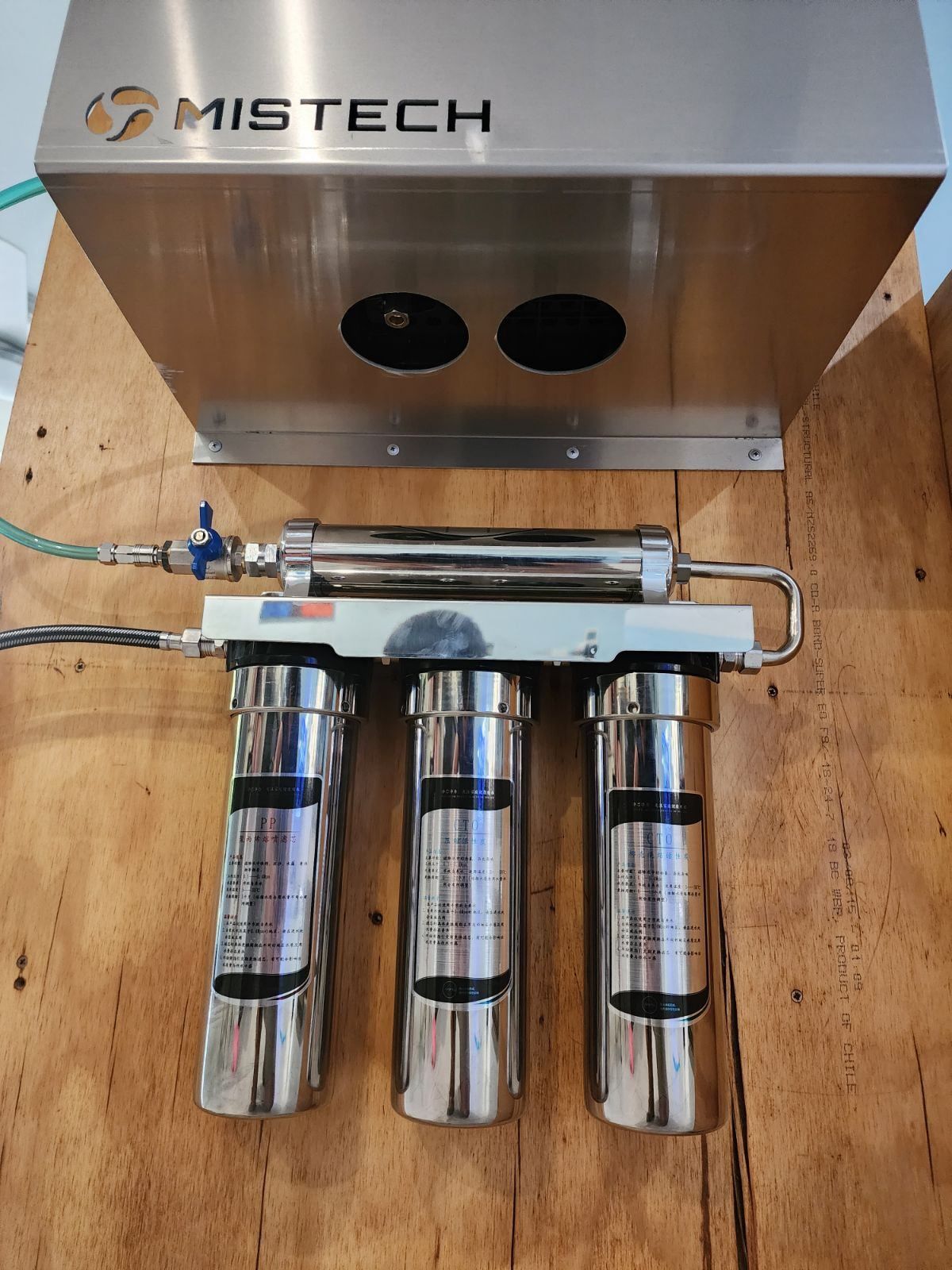
Our 4-Stage Stainless Steel Water Filter is designed specifically to protect misting systems. Each stage does a different job:
- Particle filter (polypropylene): catches sand, silt, rust and other sediment.
- Carbon filter: reduces chlorine taste and odour.
- Second carbon filter: a second carbon stage for the same purpose.
- Inline water softener (ion exchange): targets the calcium and scale that cause most nozzle blockages.
That last stage is the important one in hard water areas. By treating the calcium before it reaches the pump, the filter helps prevent blockages, extends the time between maintenance and supports a longer pump life.
The 4-stage filter suits flow rates up to 4 litres per minute. That covers our full residential range and the MistPro-400. If you're running a larger commercial pump, talk to us about filtration sized for your flow rate.
You'll find it in the water filter section of our shop.
Why Filtration Protects the Pump Too
Blocked nozzles are the obvious problem, but they're not the only one. When nozzles start to block, the pump has to work against more resistance. Sediment can also wear seals and internal parts over time. Clean, filtered water means less strain on the pump, which is the most expensive part of your system.
That's why we treat filtration as part of the system rather than an extra. It's much cheaper to change a filter cartridge than to replace a pump or a full set of nozzles.
How Often Should You Change the Filter Cartridges?
As a guide, replace the cartridges every 6 to 12 months. If your water is very hard, or the system runs every day through summer, lean towards the shorter end. If it only runs on the hottest weekends, you may get closer to a year.
A good habit is to change the cartridges at the start of each summer, so the system goes into its busiest season with fresh filtration. We supply replacement filter cartridges, so it's easy to keep spares on hand.
Do You Need a Filter If You're on Mains Water?
In soft water areas with good mains supply, some systems run for a while without problems. But a filter is still worth it. Mains water can carry sediment after pipe works or supply interruptions, and minerals build up slowly enough that you may not notice until the nozzles start failing.
If you're unsure about your water, look at your kettle or shower head. If they scale up quickly, your nozzles will too.
Filtration and Nozzle Care Go Together
A good filter dramatically reduces nozzle problems, but it doesn't remove the need for basic maintenance. Plan to inspect the nozzles each season, clean any that show build-up and replace any that won't spray evenly. Our anti-drip nozzles use heat-resistant seals designed to handle hot weather, and replacement nozzles are available in stainless steel or chrome-plated brass.
If you're planning a new system, factor filtration in from the start. Read more about our high-pressure misting systems, browse the shop for filters and spare parts, or see our installation advice for setup ideas.
Frequently Asked Questions
Do misting systems need a water filter?
Yes. High-pressure nozzles have very small openings, and minerals or sediment in the water will block them over time. A filter protects both the nozzles and the pump, and it's essential if you're using tank or bore water.
Why do misting nozzles block up?
Mostly because of hard water and sediment. Calcium and other minerals leave scale inside the nozzle, and particles of sand, rust or debris can lodge in the opening. Water sitting in the line between uses can make it worse.
What water do you use in a misting system?
Clean water that's free of sediment, usually household mains water. Tank and bore water can also be used, but they need good filtration first, because they tend to carry more sediment and minerals.
How do you stop misting nozzles clogging?
Fit a quality filter with a softening stage, change the cartridges every 6 to 12 months, and check the nozzles each season. Clean or replace any nozzle that shows build-up or sprays unevenly.
Not sure what filtration your system needs? Contact us or call 07 4946 4702 and we'll help you match the filter to your water and your pump.