
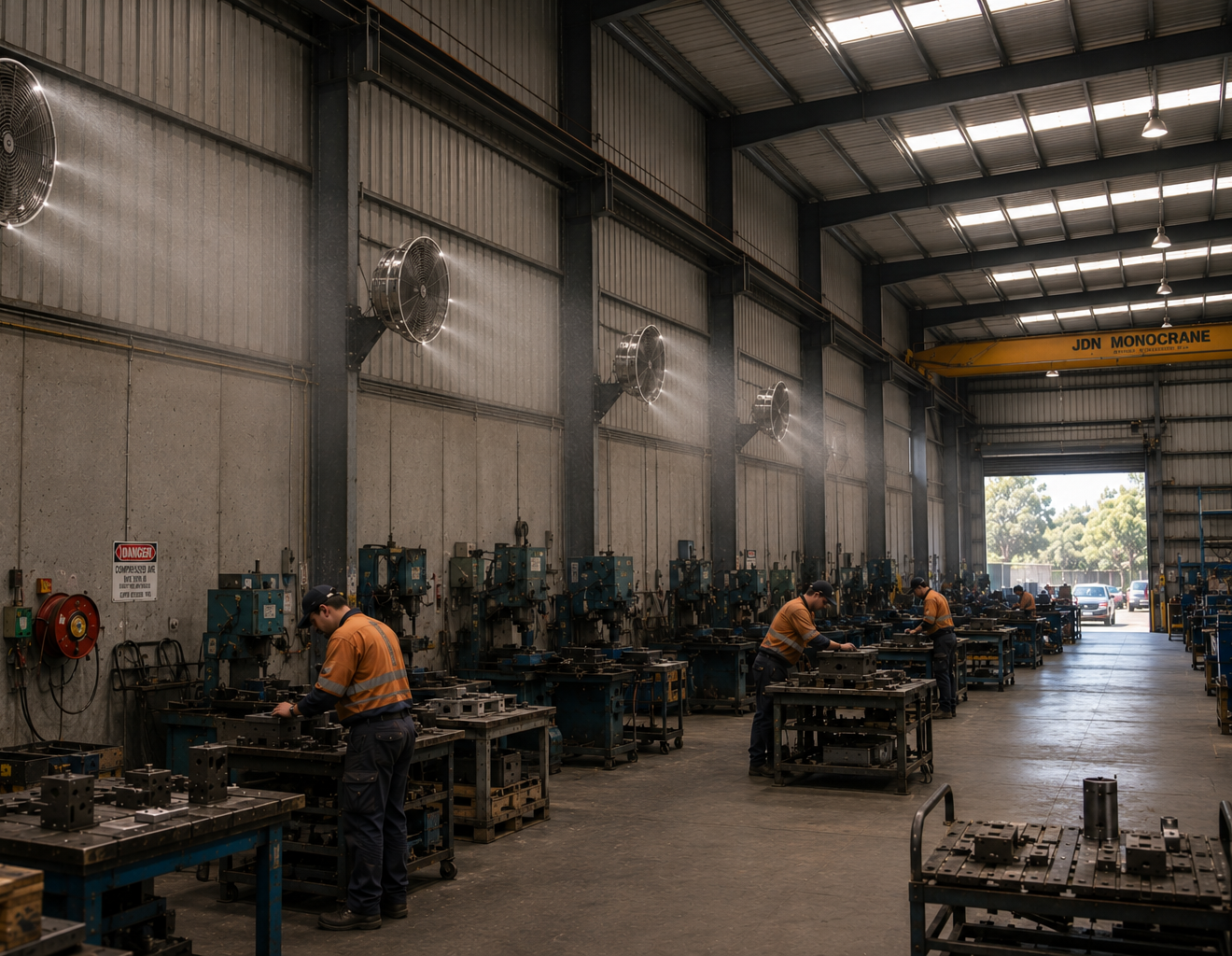
Factories, workshops and warehouses are some of the hardest places in Australia to keep cool. The spaces are big, the doors are often open, and air conditioning the whole building is usually impractical or far too expensive. Industrial misting systems take a different approach. Instead of trying to cool an entire facility, they put cool air where people are actually working.
There are usually two reasons a business comes to us: keeping workers safe and productive in the heat, or keeping dust down in a particular area. Sometimes it's both. They're different problems, so we'll cover them separately.
Use Case 1: Managing Heat Stress for Workers
Why heat is a workplace safety issue
Heat isn't just uncomfortable. Under Australian work health and safety laws, a business has a duty to keep workers safe from the risks of working in heat. Safe Work Australia notes that workers can suffer heat-related illness when the body has to work too hard to keep cool or starts to overheat.
In practice, that's a real concern in tin-roofed sheds, workshops with hot machinery, warehouses with loading docks open to the afternoon sun, and outdoor sites with little shade. Cooling is one part of managing that risk, alongside the usual measures like shade, water, rest breaks and adjusting work hours on the hottest days.
How misting fans help
An industrial misting fan combines strong airflow with ultra-fine mist from a high-pressure pump. The fan moves air across the work area, which on its own makes people feel cooler. The mist adds evaporative cooling on top. As each tiny droplet evaporates, it absorbs heat from the surrounding air and lowers the temperature in the zone the fan is aimed at.
Because the droplets are so fine, they evaporate before they settle. People and equipment stay dry, which matters in a workplace where wet floors or damp stock would create problems of their own.
Where they work best
- Workstations and assembly areas: fans aimed at the spots where people stand for long periods.
- Loading docks and roller doors: where hot air pours in and the space is too open to air-condition.
- Break areas: giving workers a properly cool place to recover between tasks.
- Outdoor sites: around scaffolding, tool stations and assembly zones, where there's no building to cool at all.
We've written separately about cooling in mining operations, where the same principles apply on a larger scale.
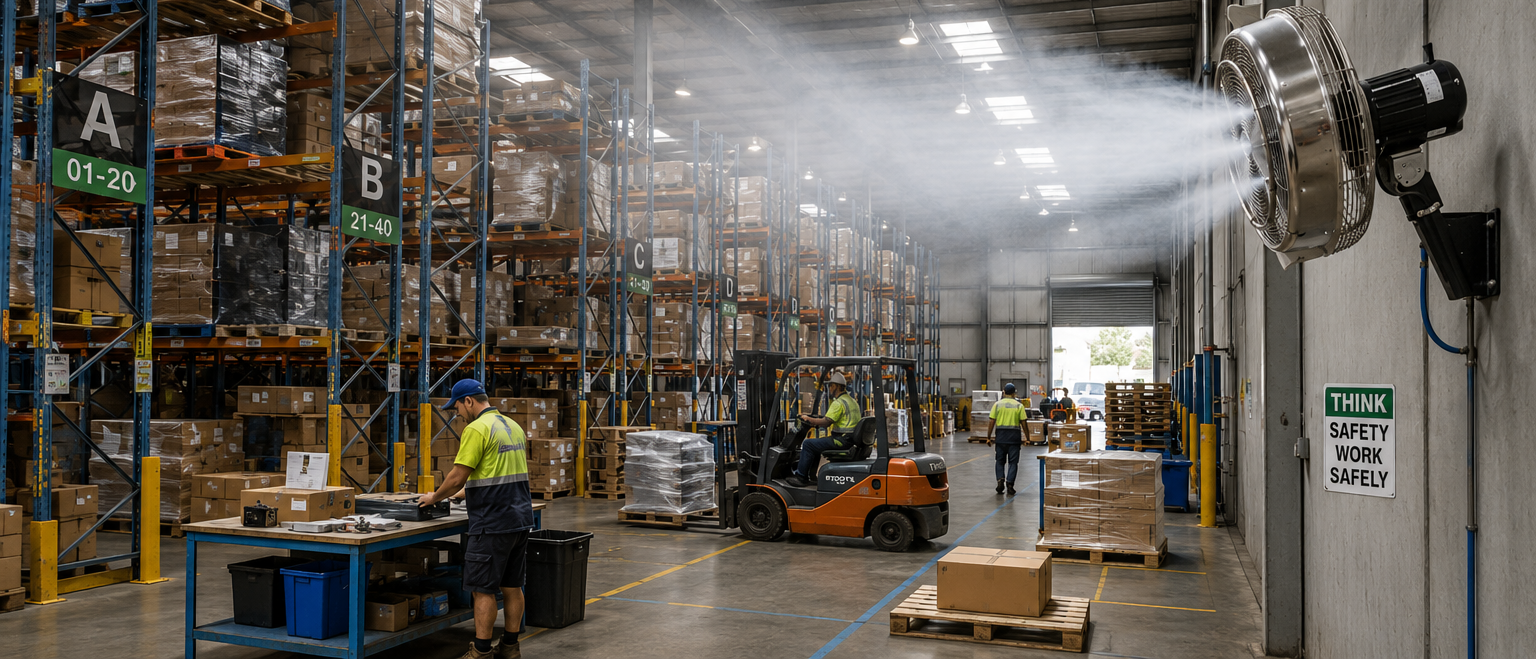
Use Case 2: Localised Dust Control
How mist helps with dust
Fine mist droplets can capture airborne dust particles. As the droplets and dust combine, they become heavier and settle out of the air. In the right setting, a misting system can cool a work area and reduce airborne dust at the same time.
Where it fits, and where it doesn't
It's important to be realistic here. A misting system can help with localised dust in smaller applications, such as workshops, transfer areas and around conveyor systems. It isn't a replacement for a purpose-built dust suppression system on a large quarry, demolition site or bulk materials operation, and it doesn't replace the dust controls your site is required to have.
Where it does fit, it's a useful second benefit from a system you're installing for cooling anyway.
Choosing an Industrial System
Choosing an industrial misting system involves more than picking a fan. Every site is different, and the right setup depends on a few things.
The size and layout of the area
Large spaces are rarely cooled as a whole. We look at where people actually work and direct the cooling to those zones. That might mean several fans spread along a production line, or a few concentrated around a loading area.
The right fans
For commercial and industrial sites, we offer two wall-mounted MTC Series fans:
- MTC-450: an 18 inch (450 mm) stainless-steel fan with a 5-nozzle misting ring and a mist throw of around 6 to 8 metres.
- MTC-600: a 24 inch (600 mm) stainless-steel fan with a 6-nozzle misting ring and a mist throw of around 6 to 10 metres.
Both are IP54 rated for outdoor use, corrosion resistant, oscillating and run on three speeds. You can see them on our industrial misting fans page or in the misting fans section of our shop.
The right pump
The fans run off a high-pressure pump, so the pump has to be sized to the number of fans and nozzles on the system. Our commercial MistPro pumps can support from 70 nozzles, depending on the model, with app control and built-in maintenance reminders.
Airflow and ventilation
Evaporative cooling adds moisture to the air. In open or semi-open spaces that moisture moves away and the cooling works well. In a closed building with poor ventilation, humidity can build up and the cooling effect drops. Part of designing a good system is making sure there's enough air movement for the mist to keep evaporating.
Water quality
Industrial sites often run long lines and many nozzles, so clean water matters even more. Filtration protects the nozzles from scale and sediment and helps the pump last longer.
Outdoor and Temporary Sites
Not every workplace has walls. On construction sites, at outdoor events and in temporary work areas, a misting system can be set up around scaffolding, break areas and tool stations. Our quick-connect fittings make it practical to set up a system for a season and relocate it as the work moves.
For hospitality and venue settings rather than industrial ones, our commercial misting fans page covers options for cafés, pubs and outdoor dining.
Getting the Design Right
The biggest mistake we see is buying fans first and working out the layout later. A few fans in the wrong spots will make very little difference. A well-planned system puts the cooling exactly where your people are.
Talk to us about your site, the areas you need to cool and what you're trying to achieve. We'll help you work out a suitable fan and pump configuration, and our installation advice page shows some of the ways systems can be mounted on different structures.
Frequently Asked Questions
How do factories cool large open spaces?
Rather than cooling the whole building, many factories use targeted cooling. Industrial misting fans combine airflow with ultra-fine mist from a high-pressure pump, and they're aimed at the areas where people work, such as workstations, loading docks and break areas.
What is used for dust suppression on industrial sites?
Large sites use purpose-built dust suppression systems. In smaller applications, such as workshops, transfer areas and around conveyors, a high-pressure misting system can also help with localised dust, because fine droplets capture airborne particles and help them settle.
How do you cool a workshop or warehouse?
Identify where people work, then direct cooling to those zones with wall-mounted misting fans running off a high-pressure pump. Make sure the space has enough ventilation for the mist to evaporate, and use filtered water to protect the system.
How do you manage heat stress for outdoor workers?
Use a combination of controls: shade, water, rest breaks, scheduling heavy work for cooler parts of the day, and cooling such as misting fans in break areas and work zones. Businesses have a duty to manage the risks of working in heat, and Safe Work Australia publishes guidance on how to do it.
Need help cooling your industrial site? Contact us or call 07 4946 4702 to talk through your space.