
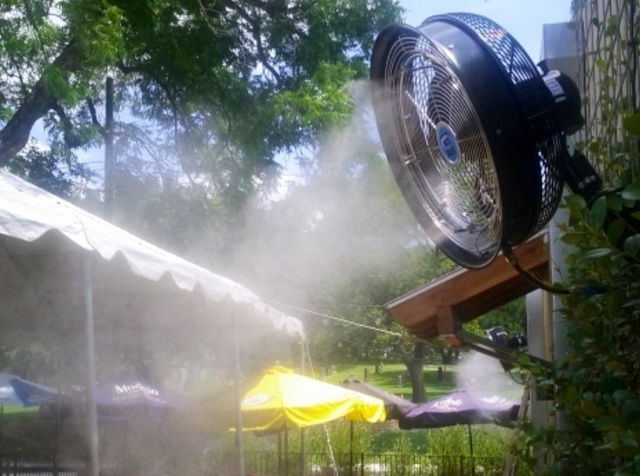
Yes, misting systems work in humid climates, but airflow is the key. On a humid day the air is already holding a lot of moisture, so mist evaporates more slowly. Add a fan and the picture changes. Moving air spreads the mist, helps it evaporate and puts a cool breeze across your skin. That's why, in humid conditions, misting fans work much better than a misting line on its own.
We're based in North Queensland, so humid summers aren't theory for us. We deal with them every year. This guide explains what humidity does to a misting system, and how to set one up so it keeps working when the air is thick.
How Humidity Affects Misting
Misting cools through evaporation. A high-pressure pump forces water through fine nozzles at around 1,000 psi, creating droplets as small as 8 to 10 microns. As those droplets turn to vapour, they absorb heat from the surrounding air, and the temperature drops.
How much the temperature drops depends on how much more moisture the air can take. Dry air can absorb a lot, so evaporation is fast and the cooling is strong. Humid air is already close to full, so evaporation slows down and the temperature drop is smaller.
That's the trade-off. In hot, dry inland heat, misting delivers its biggest temperature drops. On a sticky coastal afternoon, the drop is smaller. But that's only part of how you feel the heat, and it's where airflow comes in.
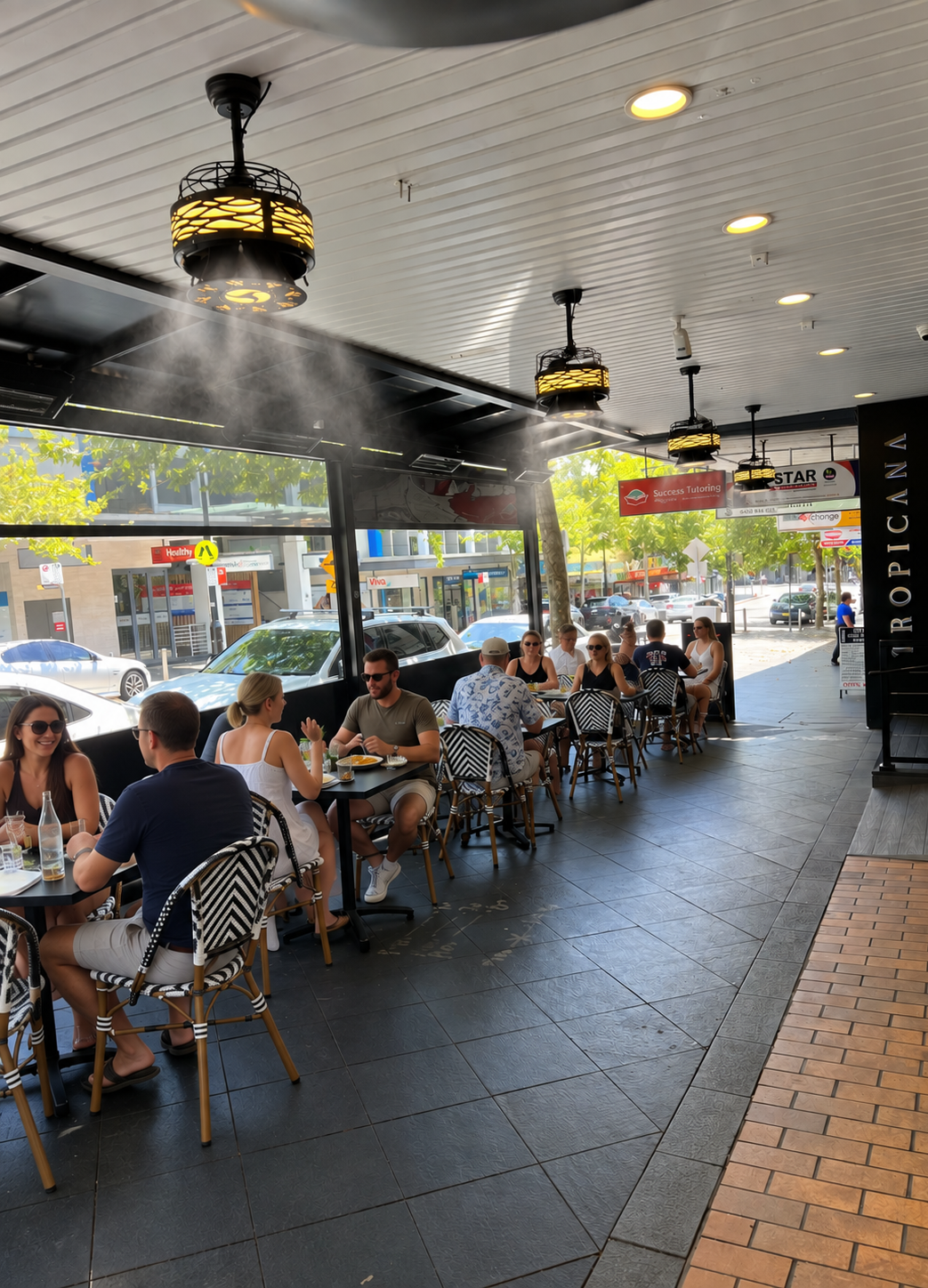
What You'll Notice on a Humid Day
Without enough airflow, a misting system in humid weather can:
- Cool the air less than it would on a dry day
- Leave mist hanging in the air instead of disappearing
- Feel a little damp if you sit close to the nozzles
- Make an enclosed space feel muggy if the moisture has nowhere to go
All of these come back to the same cause: the mist isn't evaporating fast enough. Fix the airflow and you fix most of the problem.
Why Airflow Changes Everything
Our experience in the tropics is simple: if you want misting to work in humidity, add airflow. A fan does three jobs at once:
- It spreads the mist. Instead of staying near the nozzles, the mist is carried across the space.
- It speeds up evaporation. Moving air carries away the moist air around each droplet and replaces it with air that can absorb more water.
- It cools your skin directly. A breeze helps sweat evaporate from your skin, so you feel cooler even when the air temperature drop is modest.
That combination is why our misting fans are the system we recommend most often for humid areas. They pair a fan with a ring of high-pressure misting nozzles and run off a high-pressure pump. Our MTC misting fans have a mist throw of 6 to 10 metres, depending on the model. You can read more about how they work in our guide to how a misting fan works.
Misting Line or Misting Fan in a Humid Climate?
| Misting line | Misting fan | |
|---|---|---|
| How it cools | Evaporation only | Evaporation plus airflow |
| Best conditions | Dry heat or a reliable breeze | Humid or still days |
| Coverage | A curtain of mist along a pergola, fence or gutter | A focused zone in the direction the fan points |
| Feel in humidity | Smaller cooling effect | Noticeable cooling breeze |
For many homes in humid areas, the best answer is both. A misting line around the edge of the patio creates a cooler zone, and a misting fan pushes that cool air to where people sit. Both can run off the same high-pressure pump.
How to Set Up Misting for a Humid Climate
Add airflow first
Plan for a misting fan, or make sure the space gets a reliable breeze. Ceiling fans in a pergola or alfresco area also help move the air.
Keep the space open
Misting works best in open or semi-enclosed spaces. In a fully closed space, the moisture has nowhere to go and humidity builds up. Make sure at least one or two sides are open so the moist air can move out.
Mount on the breeze side
On the coast, the afternoon breeze often comes from a predictable direction. Mount the misting line on the side the breeze comes from, so it carries the mist into your space as it evaporates. Our installation advice page shows the structures systems can be mounted on.
Use cyclic timing
Running mist nonstop on a humid day can saturate the air in your space. A cycle of mist on, mist off gives each burst time to evaporate before the next one. The EcoMist 50i and our MistPro pumps have cyclic timing built in, and the MistPro range adds app control.
Don't over-nozzle
More nozzles don't mean more cooling when the air can't absorb the extra water. Size the system to the space, and let the fan do the rest.
Run it when it's hottest
Relative humidity usually drops as the day heats up, so there's often more room for evaporation in the afternoon, which is exactly when you want the cooling.
Stick with high pressure
Fine droplets matter even more in humid weather. Low-pressure systems that run off a garden tap produce larger droplets that struggle to evaporate in humid air, and that's when things get wet. A true high-pressure misting system gives every droplet the best possible chance to evaporate.
Is Misting Effective in Queensland?
Yes. Queensland has both humid coastlines and hot, dry inland areas, and misting works across both. Inland, a misting line along a patio or fence can deliver strong cooling on its own. On the coast and in the tropics, pairing the misting with airflow is what makes the difference. Our residential misting systems can be paired with misting fans where the extra airflow is needed.
What Is the Best Outdoor Cooling for a Humid Climate?
Start with shade, because it blocks the sun's direct heat. Then add airflow and high-pressure mist together. In our experience, that combination works best in humid conditions. You can see the range of options on our outdoor cooling page.
Frequently Asked Questions
Do misting systems work in humid weather?
Yes, but airflow is the key. Humidity slows evaporation, so the temperature drop is smaller than on a dry day. Adding a misting fan spreads the mist, speeds up evaporation and creates a cooling breeze, which makes misting effective even in humid conditions.
What is the best outdoor cooling for a humid climate?
Shade combined with high-pressure misting fans. The shade blocks direct sun, the mist cools the air and the fan keeps the air moving so the mist evaporates and you feel the breeze.
Does evaporative cooling work in the tropics?
It works, but it's less effective than in dry heat because the air is already moist. Outdoors, combining high-pressure mist with strong airflow gives the best results in tropical conditions.
Is misting effective in Queensland?
Yes. Misting works well across inland Queensland, and in humid coastal and tropical areas it works best when paired with misting fans or a reliable breeze.
Live somewhere humid and want to know what will work for your space? Contact us or call 07 4946 4702.